

If your furnace igniter glows but no flame appears, the problem may involve the gas supply, burner assembly, safety controls, or gas valve, not necessarily the igniter itself. Identifying where the ignition sequence stops can help you avoid replacing a component that still works. In this guide, BlueStars Parts explains common causes, safe troubleshooting checks, and when to call an HVAC technician.
Quick Diagnosis: Why Your Furnace Igniter Glows but No Flame Appears
If your furnace igniter glows but the burners won't light, match the symptoms below to possible causes before replacing any parts.
| Symptom | Likely Cause | First Check | Fix Level |
|---|---|---|---|
| Igniter glows dimly | Igniter or power issue | Check error code | Pro |
| Glows but no valve click | Control or valve fault | Check error code | Pro |
| Valve clicks; no flame | Gas supply or valve issue | Check supply status | Pro |
| Repeated ignition lockout | Ignition or safety fault | Record error code | Pro |
| Other gas appliances fail | Gas supply interruption | Check utility notices | Utility / Pro |
| Igniter cracked or blistered | Damaged igniter | Visual check, power off | Pro |
| Flame lights, then dies | Flame-sensing fault | Note shutdown timing | Pro |
| Igniter bent or misaligned | Mounting or part issue | Check model specifications | Pro |
Safety Note: Igniter brightness and gas valve clicking alone cannot confirm a failed component. Observe only through an approved viewing window with all safety panels installed. If you smell gas, leave immediately and contact your gas utility or emergency services from a safe location.
1. Common Reasons Your Furnace Igniter Glows but No Flame Appears and How to Fix Them
When your furnace igniter glows but the burners remain unlit, the problem may involve the gas supply, igniter condition, gas valve, control board, or burner assembly. Check the following causes to narrow down the issue before replacing any parts.
1.1. Gas Supply Shut Off at the Manual Valve
The manual gas shutoff valve supplying the furnace may have been closed during maintenance or accidentally turned off. In this case, the igniter may glow normally, but no gas reaches the burners to produce a flame.
How to Fix:
- Step 1: Locate the external gas shutoff valve using your furnace manual.
- Step 2: If the valve appears closed or its position is unclear, ask an HVAC technician to verify it.
- Step 3: Never force the valve, loosen gas fittings, or attempt gas-line repairs yourself.
Quick Test: If other gas appliances work but the furnace does not ignite, the issue may involve the furnace's gas supply or ignition system. Professional inspection is needed to confirm the cause.

External furnace gas shutoff valve used to control the gas supply (Source: BlueStars Parts)
1.2. No Gas to the House or a Closed Main Supply
A utility supply interruption, a closed main gas valve, or an empty propane tank can prevent gas from reaching the furnace. If several gas appliances stop working simultaneously, the issue may extend beyond the furnace itself.
How to Fix:
- Step 1: If there is no suspected gas leak, check whether other gas appliances are working.
- Step 2: Check your gas utility's outage notices or propane supply status.
- Step 3: Contact your gas supplier if the supply is interrupted. Do not attempt to restore or repair gas connections yourself.
Quick Test: If multiple gas appliances stop working, a broader gas supply interruption is more likely than an isolated furnace igniter failure.
Safety Note: If you smell gas, do not test appliances or operate electrical switches. Leave the building and contact emergency assistance from outside.
1.3. Weak Hot Surface Igniter
A hot surface igniter may glow without reliably igniting the gas if its heating element has deteriorated, developed internal damage, or receives an incorrect electrical supply. However, a glowing igniter does not automatically mean it needs replacing; its condition and electrical specifications should be checked first.
How to Fix:
- Step 1: Turn off furnace power before any permitted visual inspection. Do not touch the fragile heating element.
- Step 2: Have an HVAC technician test the igniter's electrical supply and condition according to the manufacturer's specifications.
- Step 3: Replace the igniter only if it is confirmed defective, damaged, or incompatible.
Recommended Replacement Parts
If testing confirms a faulty hot surface igniter, BlueStars Parts offers these model-specific replacements:
- 20261709S Furnace Ignitor Hot Surface: Designed for compatible Goodman, Amana, and Janitrol furnaces, this silicon carbide igniter heats to initiate burner ignition. It may replace a confirmed defective igniter using part numbers 20261709, 0130F00014, or 594465. Check your furnace model and original part number before ordering.
- B1401018 Furnace Igniter Hot Surface Ignitor: This silicon carbide igniter is designed for select Goodman, Amana, Janitrol, and Modine furnaces. It helps restore reliable burner ignition when the original igniter has failed and cross-references part numbers B1401018S, B1401015, 41-418, and IG418. Verify the connector, mounting configuration, and exact furnace compatibility before purchasing.
For more compatible heating and ignition components, explore Furnace Heating-Temperature Parts at BlueStars Parts.
Quick Test: A glowing igniter is not necessarily defective. A technician should confirm the electrical and ignition conditions before recommending replacement.
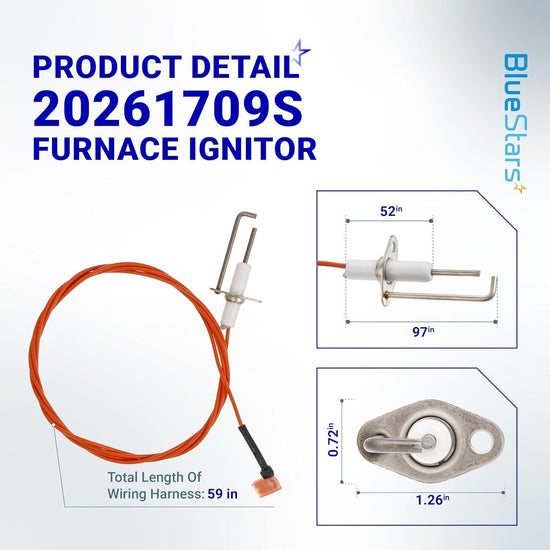
20261709S Furnace Hot Surface Ignitor for compatible Goodman, Amana, and Janitrol furnaces (Source: BlueStars Parts)
1.4. Cracked, Blistered, or Misaligned Igniter
Repeated heating cycles, accidental impact, improper handling, or incorrect installation can damage the igniter. A cracked element may fail to ignite the gas, while a misaligned igniter may not sit in the correct position relative to the burner.
How to Fix:
- Step 1: Turn off furnace power and allow the igniter to cool before inspection.
- Step 2: Check for visible cracks, blistering, or broken elements without touching the igniter.
- Step 3: Have a technician replace damaged igniters or correct mounting and alignment issues. Never bend the heating element.
Quick Test: Visible damage or incorrect mounting may indicate a problem, but electrical testing is needed to confirm igniter performance.
1.5. Faulty Gas Valve or Dead Solenoid Coils
The gas valve may fail to open because its solenoid coils are defective, the valve itself is damaged, or the control system is not supplying the required electrical signal. A glowing igniter followed by no burner flame can be consistent with a gas valve problem, but it does not prove the valve has failed.
How to Fix:
- Step 1: Record the furnace error code and note where the ignition sequence stops.
- Step 2: Have an HVAC technician test the gas valve's electrical signal, solenoid operation, and gas pressure.
- Step 3: Replace the valve only if testing confirms a defect. Never attempt DIY gas valve repairs.
Quick Test: If the igniter glows but no flame appears, a technician can check whether the gas valve receives the correct signal. The absence of an audible click alone does not confirm valve failure.
Safety Note: Never bypass the gas valve or manually release gas to test ignition.

Furnace gas valve and solenoid assembly controlling gas flow to the burners (Source: BlueStars Parts)
1.6. Faulty Control Board or Relay
Cause: The furnace control board coordinates the igniter, gas valve, and safety devices. Faulty wiring, grounding, relays, or safety inputs can interrupt ignition even when the igniter glows.
For broader diagnostic checks, read our Furnace Troubleshooting guide, covering common heating, ignition, and control-system problems.
How to Fix:
- Step 1: Check thermostat settings and record visible error codes.
- Step 2: Avoid touching live wiring or testing energized components.
- Step 3: Have a technician inspect the control board, relay, grounding, wiring, and safety circuits.
Quick Test: If the igniter activates but the gas valve receives no valid command, a control-circuit or safety-interlock fault may be responsible. Professional testing is required before replacing parts.
1.7. Blocked Burner Orifices
Rust, accumulated debris, or contamination in the burner assembly can obstruct gas flow or prevent the flame from carrying across the burners. In some cases, the igniter operates normally, but the burner does not receive or ignite gas as intended.
How to Fix:
- Step 1: Stop using the furnace if ignition repeatedly fails or you notice delayed ignition, popping, or uneven flames.
- Step 2: Have a qualified HVAC technician inspect and clean the burners and orifices.
- Step 3: Never insert needles into gas orifices, adjust gas pressure, or disassemble gas connections yourself.
Quick Test: If only some burners light, a blocked burner or crossover issue may be involved. If none ignite, the technician should also inspect the gas supply, valve, and ignition controls.

Furnace burner tubes and gas orifices requiring inspection for possible blockages (Source: BlueStars Parts)
2. Furnace Igniter Glows But No Flame: When Should You Call a Professional?
If the igniter glows but the burners fail to light, professional diagnosis may be needed to identify gas, electrical, or ignition-system faults.
Contact an HVAC Technician If:
- Repeated ignition failure: The furnace attempts ignition several times or enters lockout.
- Suspected gas valve failure: The igniter glows, but the burners never light.
- Damaged igniter: Cracks, blistering, or mounting damage are visible.
- Flame shuts off quickly: Burners ignite but go out within seconds.
- Recurring error codes: Ignition or safety-control faults continue.
- Gas supply problems: Multiple appliances stop working or the supply is interrupted.
- Complex repairs: Testing gas valves, wiring, control boards, or burner assemblies is required.
If the burners light briefly before shutting off, explore our Bad Flame Sensor Symptoms guide to understand how flame-sensing problems differ from igniter failure.
Before calling, record your furnace model, diagnostic codes, and the point where the ignition sequence stops. This can help the technician identify the problem more efficiently.
Emergency Warning: If you smell gas, evacuate immediately and contact your gas utility or emergency services from a safe location. Do not restart the furnace.

HVAC technician inspecting the furnace burner assembly and ignition system (Source: BlueStars Parts)
3. How to Prevent Furnace Ignition Failure
Regular maintenance helps reduce ignition failures and keep your furnace operating reliably.
- Schedule annual maintenance: Have a technician inspect the igniter, burners, gas valve, flame sensor, and electrical connections.
- Replace dirty filters: Check regularly and replace filters according to the manufacturer's recommendations.
- Keep burners clean: Arrange professional cleaning to remove dust, rust, and debris from burner components.
- Inspect the igniter: Check for visible cracks or damage during permitted power-off inspections. Never touch the heating element.
- Maintain the flame sensor: A dirty sensor may cause burners to shut off shortly after ignition. See our How to Clean a Furnace Flame Sensor guide for inspection and maintenance guidance.
- Use compatible igniters: Match the model, part number, voltage, connector, and mounting configuration.
- Keep outdoor vents clear: Remove snow, leaves, and debris from accessible intake and exhaust openings.
- Address ignition faults early: Record error codes and seek service instead of repeatedly resetting the furnace.
- Check thermostat and power: Verify Heat mode, thermostat batteries, and external power controls.
Safety Note: Stop troubleshooting if you suspect a gas leak, combustion problem, or repeated ignition lockout. Contact a qualified HVAC technician.

Routine furnace maintenance helps prevent ignition faults and unexpected heating failures (Source: BlueStars Parts)
4. FAQs: Furnace Igniter Glows but No Flame
4.1. Can an Igniter Glow and Still Be Bad?
Yes. A hot surface igniter can glow but still fail to reach the temperature needed to ignite gas reliably. A technician can test its resistance and power supply against the furnace manufacturer's specifications to confirm whether replacement is necessary.
4.2. Why Doesn't the Gas Valve Open When the Igniter Glows?
The control board opens the gas valve only after the required safety checks are satisfied. A faulty pressure switch, wiring problem, failed control board, or defective gas valve can interrupt this sequence. A qualified HVAC technician should test the safety circuit and valve operation before replacing any component.
4.3. How Hot Does a Furnace Igniter Need to Get to Ignite Gas?
A hot surface igniter must reach the operating temperature specified for its design to ignite the gas reliably. The required temperature varies by igniter material and furnace model. Glow color alone cannot confirm proper operation, so a qualified technician should verify electrical and ignition performance using the manufacturer's specifications.
4.4. Why Did My New Igniter Fail Within a Few Weeks?
A new igniter may fail prematurely due to incorrect voltage, an incompatible part, installation damage, contamination, or an unresolved furnace problem. Have a technician inspect the ignition system and verify the replacement's specifications before installing another igniter.
When your furnace igniter glows but no flame appears, the problem may involve the gas supply, igniter, gas valve, control board, or burner assembly. Identifying where the ignition sequence fails helps avoid unnecessary part replacements.
If professional diagnosis confirms that a component needs replacement, explore Furnace Parts at BlueStars Parts for compatible options. Always verify your furnace model and original part number before purchasing.
Contact Information:
8 The Green, Ste A, Dover, Delaware 19901-3618, United States
Website: https://bluestarsparts.com/
Explore Related Articles
Explore more furnace troubleshooting guides from BlueStars Parts:
- Furnace Not Igniting: Causes, Fixes & Troubleshooting Guide – Identify common ignition failures and understand where the furnace startup sequence stops.
- Furnace Won't Turn On: 7 Common Causes and How to Fix Them – Troubleshoot thermostat, power, ignition, and safety-related startup problems.
- Furnace Blowing Cold Air? Here's Why and How to Fix It – Explore common reasons a furnace runs without delivering warm air.
- Furnace Keeps Turning On and Off? Causes and Fixes – Diagnose repeated heating shutdowns and short cycling.
References
- Carrier. (2026, October 13). Furnace Gas Valve Guide.
- Carrier. (2026, October 13). Furnace Ignitor: Understanding Its Function and Importance.
- Carrier. (2026, October 13). Furnace Flame Sensor: What It Is, Why It Fails, and How to Fix It.
- Trane. (n.d.). Why Is My Furnace Not Igniting?.
- Trane. (n.d.). Furnace Not Turning On? Try These Troubleshooting Tips.
- Goodman Manufacturing Company, L.P. (2013). AMH8, GMH8, GDH8, ADSH8 Service Instructions.


