

If your furnace blower is not working, your heating system may fail to circulate warm air, even when the furnace turns on. Common causes include incorrect thermostat settings, a tripped circuit breaker, restricted airflow, or faulty components. In this guide, BlueStars Parts walks you through 9 common causes of furnace blower failure, warning signs to watch for, and practical troubleshooting steps you can safely follow.
Quick Diagnosis: Why Your Furnace Blower Isn't Running
Match your furnace blower symptoms to a possible cause and start with the safest basic check.
| Symptom | Likely Cause | First Check | Fix Level |
|---|---|---|---|
| Blower hums but won't spin | Capacitor, motor, jam | Stop; note humming | Pro |
| No sound or LED | Power or fuse issue | Check breaker | DIY → Pro |
| Burners light; no blower | Motor or control fault | Check filter, status | Pro |
| AUTO works; ON doesn't | Fan-control issue | Check thermostat | DIY → Pro |
| Blower starts, then stops | Motor or control fault | Check filter, codes | DIY → Pro |
| Blower wheel is stuck | Bearings or obstruction | Stop; inspect visually | Pro |
| Burning electrical smell | Motor or wiring fault | Turn off power | Pro |
| Runs only when panel is pressed | Door switch or panel | Check panel fit | DIY → Pro |
Note: DIY → Pro means basic homeowner checks are possible, but unresolved faults require professional service.
Safety Note: Turn off power before inspection. Never bypass safety switches, force a stuck blower wheel, or handle internal electrical components.
1. Safety First: Before You Open the Furnace
Before troubleshooting your furnace blower, follow these safety steps to prevent electrical shock, overheating, or accidental operation.
- Step 1: Disconnect Power. Turn off the furnace at its dedicated breaker or service switch before opening any panel.
- Step 2: Let the Furnace Cool. Wait for the burners and internal components to cool before inspection.
- Step 3: Protect Safety Controls. Never bypass the door switch or run the furnace with access panels removed.
- Step 4: Avoid Electrical and Moving Parts. Do not touch capacitors, exposed wiring, or internal blower components. Never force a stuck wheel.
- Step 5: Check for Warning Signs. Stop if you notice burning odors, smoke, or damaged wiring. Follow your owner's manual and seek professional help.
Safety Note: Homeowners can check thermostat settings, accessible air filters, and vents. Leave capacitor testing, electrical measurements, and motor repairs to qualified HVAC technicians. If you smell gas or suspect carbon monoxide exposure, leave the building and seek emergency assistance from a safe location.

Turning off furnace power before inspecting the blower assembly (Source: BlueStars Parts)
2. Common Reasons Your Furnace Blower Isn't Working and How to Fix Them
A furnace blower depends on several components working together. If any of these components fails, the blower may not start, may stop unexpectedly, or may run without delivering sufficient airflow (Yin et al., 2016). The following 9 causes explain what can go wrong and how to approach each problem safely.

9 potential causes of furnace blower trouble, including electrical, mechanical, and airflow-related issues (Source: BlueStars Parts)
2.1. Thermostat Set Incorrectly or Not Calling for Heat
Cause: Incorrect thermostat settings, depleted batteries, or a faulty thermostat signal can prevent the furnace blower from starting. The fan setting also affects operation: AUTO generally runs the blower during a heating or cooling cycle, while ON requests continuous fan operation.
How to Fix:
- Step 1: Set the thermostat to HEAT and raise the temperature above the current room temperature to request a heating cycle.
- Step 2: Switch the fan setting to ON and check whether the blower responds.
- Step 3: Replace the thermostat batteries if applicable and review the programmed schedule.
- Step 4: If the blower remains unresponsive, contact an HVAC technician to inspect the thermostat signal and wiring.
Quick Test: If the blower operates during a heating cycle but not when the fan is set to ON, check the thermostat fan setting first. Wiring, configuration, or the fan-control circuit may need professional testing. If the heating system fails to start, refer to the furnace won't turn on troubleshooting guide to identify other possible causes.
2.2. Tripped Circuit Breaker or Blown Fuse
Cause: A tripped circuit breaker, blown fuse, or interrupted power supply can prevent the furnace blower and control system from operating. If the breaker trips repeatedly, an electrical short, damaged wiring, or a failing motor may be responsible.
How to Fix:
- Step 1: Check the furnace's dedicated circuit breaker and external power switch.
- Step 2: If the breaker has tripped and there are no signs of burning, moisture, or electrical damage, reset it once according to the manufacturer's instructions.
- Step 3: If the breaker trips again or the furnace remains unresponsive, leave the power off and contact a qualified technician.
- Step 4: Have a professional inspect internal fuses, wiring, and the power supply before replacing any components.
Quick Test: If the furnace has no lights or sounds, check its external power switch and breaker. If power is available but the furnace remains silent, have a technician inspect the electrical system.
If the furnace has power but the burners fail to light, see our Furnace Not Igniting guide for ignition-specific troubleshooting.

Inspecting the furnace circuit breaker and electrical supply (Source: BlueStars Parts)
2.3. Furnace Door Safety Switch Not Engaged
Cause: The furnace door safety switch interrupts operation when the blower compartment access panel is removed. A misaligned panel, damaged switch, or faulty mounting bracket can prevent the switch from engaging, leaving the furnace unable to operate.
How to Fix:
- Step 1: Turn off the furnace's electrical power.
- Step 2: Check that the access panel is correctly aligned and seated.
- Step 3: Inspect the panel for visible damage, bent edges, or missing fasteners.
- Step 4: If the furnace still does not operate, have a technician inspect the safety switch and its wiring.
Quick Test: If the furnace operates only when pressure is applied to the access panel, the panel alignment or door safety switch may be faulty. Turn off power and arrange inspection if reseating the panel does not resolve the issue. Never hold down or bypass the safety switch.
2.4. Clogged Air Filter Tripping the High Limit Switch
Cause: A clogged air filter restricts airflow and can cause the furnace to overheat. The high-limit switch may shut off the burners while the blower continues running to cool the heat exchanger. Repeated overheating can also cause heating shutdowns or lockouts, but it does not necessarily mean the blower motor has failed.
How to Fix:
- Step 1: Turn off the furnace and allow it to cool.
- Step 2: Replace a dirty filter with the correct size and type.
- Step 3: Clear obstructions from supply registers and return-air grilles.
- Step 4: If shutdowns or limit-switch faults continue, contact an HVAC technician to inspect airflow and safety controls.
Quick Test: If normal heating resumes after replacing the filter, restricted airflow may have contributed to the problem. Repeated high-limit trips require professional diagnosis.
Caution: Never bypass or repeatedly reset a high-limit switch. It protects the furnace from unsafe temperatures.
If your furnace repeatedly starts and stops due to suspected overheating, read our Furnace Keeps Turning On and Off guide for additional troubleshooting steps.
2.5. Failed Run Capacitor
Cause: A failed run capacitor can prevent a compatible blower motor from starting or maintaining normal operation. The motor may hum without spinning, but similar symptoms can also result from seized bearings, a damaged motor, or a faulty control circuit.
How to Fix:
- Step 1: Turn off the furnace and stop restarting a motor that hums without spinning.
- Step 2: Have a technician confirm whether the blower motor uses a separate run capacitor.
- Step 3: Have the technician test the capacitor and replace it only if defective, using the specified capacitance and voltage rating.
- Step 4: If the blower still fails, have the motor, wheel, and control system inspected.
Recommended Replacement Part:
If testing confirms a failed 7.5 µF run capacitor, the CBB65 7.5 uF ±5% MFD 370 or 440 Oval Run Capacitor from BlueStars Parts may be a suitable replacement for compatible furnace blower motors.
This capacitor supports the phase shift needed by compatible single-phase motors during operation. It may help restore normal motor performance when the original capacitor has failed. Before ordering, verify the required 7.5 µF capacitance, voltage rating, terminal configuration, and physical dimensions. ECM blower motors generally do not use this type of separate run capacitor.
Quick Test: A humming motor may indicate capacitor failure, but the motor and control system must also be tested. Leave capacitor handling and replacement to a qualified technician because stored electrical charge can remain after power is disconnected.
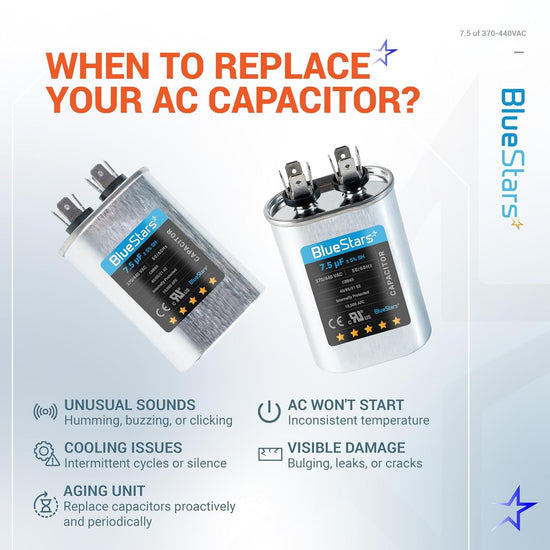
CBB65 7.5 µF ±5% 370/440V Oval Run Capacitor for compatible HVAC motors (Source: BlueStars Parts)
2.6. Seized Blower Wheel or Worn Motor Bearings
Cause: Debris, a damaged blower wheel, or worn motor bearings can prevent the blower assembly from rotating freely. The motor may hum, overheat, or produce grinding and squealing noises before the blower stops working.
How to Fix:
- Step 1: Turn off the furnace's power and allow the unit to cool.
- Step 2: Look for visible debris around the blower assembly without reaching into the mechanism or forcing the wheel to turn.
- Step 3: If the wheel appears damaged or cannot rotate freely, arrange a professional inspection.
- Step 4: Have the technician clean or replace the affected components and inspect the motor shaft, bearings, and wheel alignment.
Quick Test: A stiff blower wheel may indicate seized bearings, an obstruction, or mechanical damage. A technician can identify the exact cause after isolating power and inspecting the assembly.
2.7. Burned-Out Blower Motor
Cause: A blower motor may fail because of age, overheating, worn bearings, electrical damage, or prolonged operation under restricted airflow. Depending on the failure, the motor may remain silent, hum without spinning, or start briefly before shutting down.
How to Fix:
- Step 1: Check the thermostat settings, air filter, and external power supply.
- Step 2: Stop operating the furnace if the motor produces a burning odor, excessive heat, or persistent humming.
- Step 3: Have a technician test the motor, electrical supply, and associated starting or control components.
- Step 4: If the motor is confirmed defective, replace it with a compatible unit matching the required voltage, horsepower, speed, mounting, rotation, and furnace specifications.
Quick Test: If the motor receives the correct operating command but does not run, it may have failed. A technician should rule out a bad capacitor, relay, or control board before replacing the motor.
2.8. Faulty Blower Relay or Control Board
Cause: The furnace control board manages the blower's operating sequence, while a relay or other control component may switch power to the motor. A faulty relay, damaged wiring, or failed board can prevent the blower from starting, cause intermittent operation, or keep it running continuously.
How to Fix:
- Step 1: Confirm that the thermostat is set correctly and is requesting heating or fan operation.
- Step 2: Record any diagnostic codes or warning lights displayed by the furnace.
- Step 3: Consult the manufacturer's troubleshooting instructions and share the recorded codes with a technician.
- Step 4: Have a qualified technician test the control signals, relay, wiring, and safety inputs before replacing any components.
Quick Test: If the motor and its associated components test correctly but the blower does not respond to a valid command, the relay or control board may be faulty. Electrical testing is necessary to confirm the diagnosis.
If professional diagnosis confirms a failed electrical control component, browse Furnace Electrical-Control Parts at BlueStars Parts. Compare the original part number, electrical specifications, and furnace model before selecting a replacement.

Technician inspecting furnace control board wiring and blower relay connections (Source: BlueStars Parts)
2.9. Failed ECM Motor Module (Modern Furnaces)
Cause: Electronically commutated motors (ECMs) use electronic components to control blower speed and operation. A failed ECM module, damaged motor, interrupted power supply, or faulty control signal can prevent the blower from starting or cause irregular operation.
How to Fix:
- Step 1: Check the thermostat settings, air filter, and external power supply.
- Step 2: Record any furnace diagnostic codes related to blower operation.
- Step 3: Have a qualified technician test the ECM motor's power supply, wiring, and control signals.
- Step 4: Replace the failed ECM module or complete motor assembly as specified by the furnace manufacturer. Some replacement modules require model-specific programming or configuration.
Quick Test: If the ECM motor receives a valid operating command but does not respond, the module, motor, wiring, or control board may be responsible. Professional testing can identify the failed component; a standard run capacitor is not a universal fix for ECM motors.
3. Furnace Blower Not Working: When Should You Call a Professional?
Basic checks may resolve simple furnace blower problems, but electrical faults and mechanical failures require professional diagnosis.
Contact an HVAC Technician If:
- Blower hums but won't spin: Possible capacitor, motor, or blower wheel failure.
- Breaker keeps tripping: May indicate damaged wiring or an electrical short.
- Repeated shutdowns: The blower stops unexpectedly or the furnace overheats.
- Burning smell or smoke: Stop operating immediately and seek urgent assistance.
- Door switch problems: The furnace works only when the access panel is pressed.
- Motor or ECM failure: Internal testing, replacement, or programming is required.
- Persistent error codes: The system remains unresponsive after basic checks.
If replacement parts are needed, explore Furnace Parts at BlueStars Parts. Confirm the faulty component, furnace model, and original part number before ordering.
Safety Note: If you notice smoke or fire, evacuate and contact emergency services. If you smell gas or suspect carbon monoxide exposure, leave the building and seek emergency assistance from a safe location.
4. How to Prevent Furnace Blower Failure
Regular maintenance helps maintain airflow, reduce blower strain, and detect problems before failure.
- Replace air filters: Check regularly and replace dirty filters according to the manufacturer's instructions.
- Keep vents clear: Remove obstructions from supply registers and return-air grilles.
- Schedule HVAC maintenance: Have a technician inspect the motor, blower wheel, wiring, and safety controls.
- Check thermostat settings: Replace batteries when needed and review heating and fan schedules.
- Keep the furnace area clean: Remove dust, debris, and stored items that restrict airflow.
- Watch for warning signs: Address burning odors, repeated breaker trips, and intermittent operation promptly.
- Use compatible parts: Match replacement components to the furnace model, electrical ratings, and original part number.
Note: Preventive maintenance cannot eliminate every mechanical failure, but it can reduce avoidable airflow restrictions and help extend blower system life.
5. FAQs: Furnace Blower Not Working
5.1. Why Does My Furnace Blower Hum but Not Spin?
A humming blower may have a failed run capacitor, seized bearings, an obstructed wheel, or a damaged motor. Turn off the furnace if the motor continues humming without rotating. Have a qualified technician inspect the assembly and test the relevant components before replacing any parts.
5.2. How Do I Know If My Furnace Blower Capacitor Is Bad?
A faulty capacitor may cause the blower motor to hum without starting, start slowly, or operate intermittently. These symptoms can also indicate motor or control-system problems, so they do not confirm capacitor failure. A technician can measure the capacitance and compare it with the component's specified rating.
5.3. Is It Safe to Replace a Furnace Capacitor Myself?
Replacing a furnace capacitor can be dangerous because it may retain an electrical charge after the power is disconnected. Incorrect handling or installing an incompatible component can also cause injury or equipment damage. For most homeowners, professional testing and replacement are the safer options.
5.4. Why Does My Furnace Only Run When I Press on the Access Panel?
A misaligned access panel, faulty door safety switch, or damaged wiring may prevent the furnace from operating normally. Turn off the power and check whether the panel is seated correctly according to the manufacturer's instructions. If the problem continues, contact a technician rather than holding down or bypassing the safety switch.
When your furnace blower is not working, start with safe, basic checks such as thermostat settings, the external power supply, the air filter, and the access panel. If the blower hums without spinning, shuts down repeatedly, or produces a burning odor, stop operating the furnace and seek professional help.
Once the underlying cause has been identified, use the furnace model and original part number to select a compatible replacement. Explore BlueStars Parts to find available components for your repair and verify product specifications before ordering.
Contact Information:
8 The Green, Ste A, Dover, Delaware 19901-3618, United States
Website: https://bluestarsparts.com/
Explore Related Articles
Explore more furnace troubleshooting and repair guides from BlueStars Parts:
- Furnace Keeps Turning On and Off? Causes and Fixes – Identify short-cycling problems caused by airflow, thermostat, or safety-control issues.
- Furnace Blowing Cold Air? Here's Why and How to Fix It – Troubleshoot a furnace that runs but fails to deliver warm air.
- Furnace Troubleshooting: 11 Common Problems & Fixes – Explore common furnace problems, warning signs, and practical troubleshooting steps.
References
- Yin, P., Pate, M. B., & Sweeney, J. F. (2016). Experimental performance evaluations and empirical model developments of residential furnace blowers with PSC and ECM motors. Journal of Building Engineering, 5, 239–248. https://doi.org/10.1016/j.jobe.2016.01.002
- Alavy, M., Li, T., & Siegel, J. A. (2020). Energy use in residential buildings: Analyses of high-efficiency filters and HVAC fans. Energy and Buildings, 209, 109697. https://doi.org/10.1016/j.enbuild.2019.109697
- U.S. Department of Energy. (n.d.). HVAC Proper Installation of Filters.
- U.S. Department of Energy. (2021). Consumer Guide to Home Heating and Cooling.
- U.S. Department of Energy. (2022). Energy Saver: Tips on Saving Money and Energy in Your Home.


