

Furnace overheating occurs when a furnace becomes hotter than its normal operating range. This issue can happen due to poor airflow, component problems, or inadequate maintenance. If left unaddressed, it can lead to frequent shutdowns, reduced heating efficiency, and damage to the system. This guide from BlueStars Parts explores the warning signs, common causes of furnace overheating, and how to fix them safely.
Stop and Do This First If Your Furnace Is Overheating Right Now
If your furnace is overheating, stop heating and check for immediate hazards before troubleshooting.
- Step 1: Stop Heating. Set the thermostat to OFF. Do not repeatedly restart the furnace.
- Step 2: Check for Danger. If you notice smoke, sparks, or burning electrical odors, stay away and seek urgent assistance.
- Step 3: Leave if Necessary. If you suspect a gas leak or carbon monoxide exposure, evacuate and call emergency services from a safe location.
- Step 4: Check Airflow Safely. Once the system is cool, inspect the accessible air filter and clear blocked vents.
- Step 5: Seek Professional Help. Never bypass a high-limit switch or other safety control. Contact an HVAC technician if overheating persists.
Safety Note: Do not open electrical compartments or attempt internal repairs. Turn off furnace power only when it is safe to do so, and follow the manufacturer's shutdown instructions.
Quick Diagnosis: Is Your Furnace Overheating?
Furnace overheating may cause early shutdowns, prolonged blower operation, or diagnostic errors. Use these warning signs to identify what to check first.
| Warning Sign | Possible Cause | First Check | Fix Level |
|---|---|---|---|
| Furnace short-cycles | Airflow or control fault | Check filter, vents | DIY → Pro |
| Blower runs after heat stops | Cooldown or limit fault | Check fan setting | DIY → Pro |
| Persistent hot-metal smell | Overheating | Stop; note symptoms | Pro |
| Burning plastic or electrical odor | Wiring or electrical fault | Stop operation | Pro |
| Loud humming or vibration | Blower or motor fault | Check airflow | Pro |
| Clanging or banging | Duct expansion or damage | Note timing | DIY → Pro |
| Unusually hot furnace or vents | Excessive temperature | Stop operation | Pro |
| Flashing limit-switch error | Safety-control fault | Record error code | Pro |
Note: DIY → Pro means basic checks may be performed safely, but persistent issues require professional service.
Safety Warning: Never repeatedly reset a furnace displaying overheating or safety-control faults.
1. Common Causes of Furnace Overheating and How to Fix Them
A furnace can overheat when it generates heat faster than the system can remove it, usually because airflow is restricted or a component is not working correctly. The following causes are worth checking, starting with the simplest maintenance issues before moving to problems that require professional repair.

Seven possible causes of furnace overheating, including airflow restrictions and component faults (Source: BlueStars Parts)
1.1. Clogged Air Filter
Cause: A clogged air filter restricts the amount of return air reaching the furnace. With less air moving across the heat exchanger, heat can build up inside the system and trigger the high-limit switch. The furnace may then shut off its burners before completing the heating cycle.
How to Fix:
- Step 1: Turn off the furnace and allow it to cool.
- Step 2: Inspect the air filter for dust, lint, or debris.
- Step 3: Replace a dirty disposable filter or clean a reusable filter as instructed.
- Step 4: Check the filter's size, specifications, and airflow direction. Follow the recommended replacement schedule.
Quick Test: If airflow improves after filter maintenance, the restriction may have contributed to overheating. If short cycling or limit-switch errors continue, leave the furnace off and contact an HVAC technician.
1.2. Blocked Supply or Return Vents
Cause: Furnaces depend on a clear airflow path. Supply vents distribute heated air throughout the home, while return vents bring air back to the heating system. Furniture, rugs, curtains, dust buildup, or closed registers can interfere with this circulation and contribute to overheating (Fazli et al., 2015).
How to Fix:
- Step 1: Inspect accessible supply and return vents for blockages.
- Step 2: Move furniture, curtains, rugs, and other objects away.
- Step 3: Reopen closed supply registers unless your system requires otherwise.
- Step 4: Clean accessible vent grilles.
- Step 5: If airflow remains weak, have a technician inspect the ductwork.
Quick Test: After clearing obstructions, observe airflow during normal operation only if the furnace has been confirmed safe to restart. Repeated shutdowns require professional inspection.
Caution: Closing multiple vents can disrupt airflow balance and contribute to overheating.

Keep supply and return vents unobstructed to maintain proper furnace airflow (Source: BlueStars Parts)
1.3. Dirty Blower Wheel
Cause: The blower wheel moves air through the furnace and duct system. When dust and debris accumulate on its blades, airflow can decrease even when the motor is running. The resulting restriction may cause the heat exchanger to become too hot and activate the high-limit switch.
How to Fix:
- Step 1: Turn off furnace power before any permitted inspection.
- Step 2: Check accessible areas for visible dust buildup.
- Step 3: Arrange professional cleaning if the blower wheel is heavily coated or difficult to reach.
- Step 4: Have the technician inspect wheel damage, alignment, and vibration.
Quick Test: If overheating continues despite a clean filter and open vents, the blower assembly may need airflow testing.
Caution: Do not remove or clean internal blower components unless qualified.
1.4. Failing Blower Motor or Weak Run Capacitor
Cause: A failing blower motor can reduce airflow across the heat exchanger, causing overheating and repeated shutdowns. The motor may hum, vibrate, run slowly, or stop intermittently. On compatible PSC blower motors, a weak or failed run capacitor can also affect starting and operation. ECM motors use a different electronic control system and generally do not rely on a separate run capacitor.
How to Fix:
- Step 1: Check the air filter and accessible vents for airflow restrictions.
- Step 2: Listen for humming, grinding, or repeated motor starts without opening the cabinet.
- Step 3: Have a technician inspect the motor, electrical supply, capacitor (if equipped), and airflow.
- Step 4: Replace only confirmed defective components with model-compatible parts.
Quick Test: If the blower runs weakly or fails while the furnace repeatedly shuts down, stop using the system and arrange professional diagnosis.
1.5. Dirty Evaporator "A" Coil
Cause: In many split heating and cooling systems, the indoor evaporator coil sits above or near the furnace. Dust and debris accumulating on the coil can restrict airflow through the shared air-handling system. This may reduce the volume of air passing over the heat exchanger and contribute to overheating.
How to Fix:
- Step 1: Replace a dirty air filter.
- Step 2: Clear accessible supply and return vents.
- Step 3: If airflow remains weak, arrange an HVAC inspection.
- Step 4: Have the technician inspect and clean the evaporator coil using an appropriate method.
- Step 5: Confirm that airflow and furnace temperatures meet the manufacturer's specifications.
Quick Test: Persistent weak airflow despite a clean filter and open vents may indicate a restricted coil. Professional inspection is needed to confirm it.
Caution: Avoid household cleaners or DIY coil disassembly, which may damage fins and electrical components.
1.6. Faulty or Worn High Limit Switch
Cause: The high-limit switch is a safety control that monitors furnace temperature and shuts off the burners when the system exceeds its permitted operating range. Depending on the furnace design, the blower may continue running to cool the heat exchanger.
How to Fix:
- Step 1: Record any furnace error codes or flashing LED patterns.
- Step 2: Have an HVAC technician check whether the switch opened due to overheating or an electrical fault.
- Step 3: Have the technician inspect airflow, blower performance, wiring, and temperature controls.
- Step 4: Replace the switch only if professional testing confirms it is defective.
- Step 5: Verify safe furnace operation after correcting the underlying cause.
Quick Test: Repeated burner shutdowns or high-limit error codes require professional inspection. Never bypass the switch or repeatedly reset the furnace.
Recommended Replacement Parts
If an HVAC technician confirms that the primary high-limit switch needs replacement, BlueStars Parts offers the following model-specific options:
- L210-20F Furnace Primary Limit Switch: Designed for select ICP, Heil, and Tempstar furnaces, this safety switch opens at 210°F and resets at approximately 190°F. It helps protect the furnace by interrupting burner operation during excessive heat.
- 87F16 Furnace Primary Limit Switch: Suitable for compatible Lennox furnaces, this high-limit switch opens at 140°F and resets at 110°F. It helps prevent unsafe heating conditions by interrupting the burner circuit when the specified temperature limit is reached.
- 20162904 Furnace Primary Limit Switch: Designed for select Goodman furnaces, this temperature safety switch opens at 150°F and resets at 110°F. It provides overtemperature protection for compatible heating systems.
These switches are not interchangeable solely because they serve the same purpose. Always verify the original part number, trip and reset temperatures, electrical specifications, mounting configuration, and furnace model before ordering.
For additional compatible options, explore Furnace Electrical-Control Parts at BlueStars Parts.
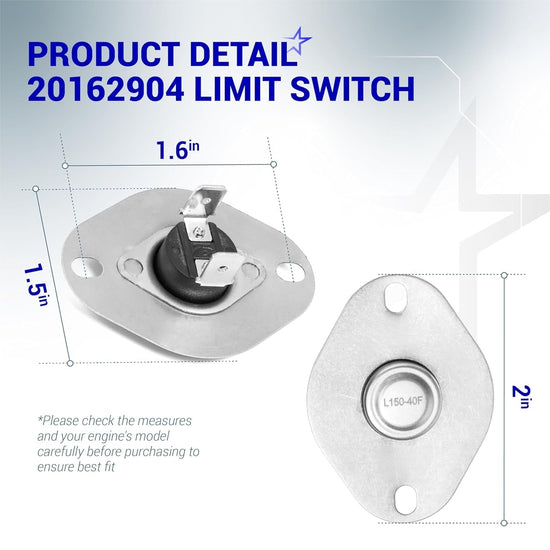
20162904 Furnace Primary Limit Switch (Source: BlueStars Parts)
1.7. Oversized Furnace or Closed-Off Ductwork
Cause: An oversized furnace may heat a home too quickly, causing frequent short cycling and uneven temperatures. Closed or restricted ductwork can further reduce airflow and contribute to overheating. However, furnace oversizing alone does not confirm an overheating problem.
For more details on frequent heating shutdowns, read our Furnace Keeps Turning On and Off guide to explore airflow, thermostat, and furnace-sizing issues.
How to Fix:
- Step 1: Check that supply and return vents are open.
- Step 2: Reopen closed registers unless otherwise specified by the manufacturer.
- Step 3: Have a technician assess ductwork, airflow, and static pressure.
- Step 4: Request a heating-load assessment if the furnace may be oversized.
- Step 5: Correct confirmed ductwork or installation problems.
Quick Test: If high-limit trips continue despite clear airflow paths and a functioning blower, arrange professional airflow and system-sizing tests. Do not assume replacing the limit switch will resolve the problem.
2. Why an Overheating Furnace Is Dangerous
Repeated furnace overheating can damage components, interrupt heating, and create serious safety risks.
- Heat exchanger damage: Excessive heat can stress the heat exchanger and shorten component life.
- Electrical hazards: Overheated motors, wiring, or components may increase fire risk.
- Repeated safety shutdowns: Frequent limit-switch trips interrupt heating and indicate an unresolved fault.
- Poor heating performance: Restricted airflow and short cycling can cause uneven heating and higher energy use.
- Carbon monoxide concerns: Gas or oil furnaces can produce CO when combustion or venting is unsafe. Overheating alone does not confirm CO exposure.
Safety Warning: Install and maintain carbon monoxide alarms. If an alarm sounds or anyone develops possible CO poisoning symptoms, leave immediately and seek emergency assistance.

Technician inspecting furnace components for possible overheating damage (Source: BlueStars Parts)
3. Furnace Overheating: When Should You Call a Professional?
Persistent overheating may indicate airflow restrictions, electrical faults, or malfunctioning safety controls that require professional diagnosis.
Contact an HVAC Technician If:
- Repeated short cycling: Burners shut off before reaching the thermostat setting.
- High-limit faults: The switch trips repeatedly or a limit-switch error appears.
- Burning odors or smoke: Stop operating and seek urgent assistance.
- Blower problems: Weak airflow, grinding, humming, or excessive vibration persists.
- Persistent error codes: Faults continue after basic checks.
- Restricted airflow: Internal coil, blower, or ductwork problems are suspected.
- Combustion or venting concerns: Leave the furnace off until professionally inspected.
A technician can measure airflow, temperature rise, and safety-control operation to identify the underlying fault.
If a confirmed defective component requires replacement, explore Furnace Parts at BlueStars Parts. Verify your furnace model and original part number before ordering.
Emergency Warning: If you notice fire, smoke, a suspected gas leak, or carbon monoxide exposure, follow emergency evacuation procedures and seek immediate assistance.
4. How to Prevent Your Furnace From Overheating
Regular maintenance helps prevent airflow restrictions and identify furnace problems before they lead to overheating.
- Replace air filters: Check regularly and clean or replace filters as recommended.
- Keep vents open: Remove obstructions from supply registers and return grilles.
- Schedule annual maintenance: Have a technician inspect the blower, heat exchanger, safety controls, and venting.
- Monitor warning signs: Watch for repeated shutdowns, burning smells, weak airflow, or unusual noises.
- Maintain a safe furnace area: Keep required clearances and test carbon monoxide alarms regularly.
- Track maintenance: Record filter changes, repairs, and recurring error codes.

Routine furnace inspections help identify airflow and overheating problems early (Source: BlueStars Parts)
5. FAQs: Furnace Overheating
5.1. What Are the First Signs That a Furnace Is Overheating?
The first signs often include short cycling, burners shutting off before the thermostat reaches its target temperature, and the blower continuing to run after the burners stop. Unusual hot-metal odors, weak airflow, excessive vibration, or a flashing high-limit error code can also indicate a problem.
5.2. Is It Safe to Keep Running a Furnace That Shuts Off Early?
No, not if the furnace repeatedly shuts off because of suspected overheating. The shutdown may be a protective response to excessive internal temperatures or a faulty safety-control circuit. Turn off the system if the problem persists, check only basic maintenance items when safe, and arrange professional inspection.
5.3. Why Does My Blower Keep Running After the Burners Shut Off?
The blower may continue running briefly after the burners shut off to remove residual heat from the heat exchanger. However, if it runs continuously or the furnace repeatedly shuts down early, restricted airflow, a high-limit switch fault, or a control problem may be responsible. Check the thermostat settings and air filter, and seek professional service if the issue persists.
5.4. Can Closing Vents in Unused Rooms Cause Overheating?
Yes. Closing too many supply vents can restrict airflow and increase pressure within the duct system, depending on the furnace and duct design. This can contribute to overheating, reduced efficiency, and uneven heating. Keep vents open unless your system's manufacturer or an HVAC professional recommends otherwise.
5.5. How Do I Find the Right Limit Switch for My Furnace Model?
You can start by locating your furnace's manufacturer, model number, and serial number on its rating plate. Consult the manufacturer's parts documentation to identify the correct limit switch, including its temperature ratings, electrical specifications, switching behavior, and mounting configuration. If you are unsure which switch is suitable, ask a qualified technician to confirm the part before purchasing or installing it.
A furnace overheating problem often begins with restricted airflow, a dirty blower, a failing motor, or an issue with the high-limit switch. Checking the filter and keeping vents unobstructed are useful first steps, but repeated shutdowns, electrical odors, and persistent error codes require professional attention.
Regular maintenance can help prevent many airflow-related problems and extend the service life of your heating system. When a technician confirms that a component needs replacement, explore BlueStars Parts to discover available furnace parts, compare product specifications, and find a compatible option for your repair needs.
Contact Information:
8 The Green, Ste A, Dover, Delaware 19901-3618, United States
Website: https://bluestarsparts.com/
Explore Related Articles
Explore more furnace troubleshooting and maintenance guides from BlueStars Parts:
- Furnace Blowing Cold Air? Here's Why and How to Fix It – Identify airflow restrictions, high-limit faults, and heating problems.
- Furnace Troubleshooting: 11 Common Problems & Fixes – Diagnose common furnace issues, from heating failures to airflow problems.
- How to Clean a Furnace Flame Sensor: Step-by-Step Guide – Learn how flame sensor buildup can affect burner operation.
- Furnace Not Igniting: Causes, Fixes & Troubleshooting Guide – Troubleshoot ignition failures and safety-related shutdowns.
References
- Fazli, T., Yeap, R. Y., & Stephens, B. (2015). Modeling the energy and cost impacts of excess static pressure in central forced-air heating and air-conditioning systems in single-family residences in the U.S. Energy and Buildings, 107, 243–253. https://doi.org/10.1016/j.enbuild.2015.08.026
- Yin, P., Pate, M. B., & Sweeney, J. F. (2016). Experimental performance evaluations and empirical model developments of residential furnace blowers with PSC and ECM motors. Journal of Building Engineering, 5, 239–248. https://doi.org/10.1016/j.jobe.2016.01.002
- ENERGY STAR. (n.d.). Maintenance Checklist.
- ENERGY STAR. (n.d.). Heat & Cool Efficiently.
- Centers for Disease Control and Prevention. (2026). Furnace Safety Fact Sheet.
- Centers for Disease Control and Prevention. (2026, October 26). Carbon Monoxide Poisoning Basics.


