

Is it worth repairing a microwave? Repair may be worthwhile when a confirmed fix costs substantially less than buying and installing a comparable replacement. In this guide, BlueStars Parts helps you compare repair and replacement costs, check warranty coverage, and consider your microwave's condition so you can make an informed decision.
Quick Answer: Should You Repair or Replace Your Microwave?
| Situation | What to check first | Next step |
|---|---|---|
| A removable tray or roller ring is damaged | The model number and manufacturer instructions | Compare the compatible accessory price with replacement cost. |
| The door is damaged or will not close securely | Manufacturer service guidance | Stop using the microwave and arrange an assessment. |
| The microwave runs but does not heat | Cooking settings and the manufacturer's troubleshooting guide | Arrange service if basic checks do not resolve the issue. |
| You have a confirmed repair quote | Parts, labor, diagnostic fees, and warranty coverage | Compare the quote with the full cost of an equivalent replacement. |
Safety first: Do not use a microwave with a damaged door or a door that does not close securely. Internal capacitors can retain dangerous voltage even after unplugging. Leave internal repairs to a qualified service professional.
1. Is It Worth Repairing a Microwave? Key Factors to Consider
Before deciding whether to repair or replace your microwave, it is important to evaluate several factors that affect cost, safety, and long-term value. Here are some factors you should pay attention to:
1.1 Microwave age and remaining lifespan
The age of the microwave is one of the biggest factors when deciding if repair is worthwhile. Most standard microwaves last between 7 and 10 years with regular use. If the appliance is still relatively new and has not experienced repeated breakdowns, repairing minor issues is usually a practical decision.
However, older microwaves often develop multiple worn parts, making replacement a more cost-effective option in the long run. When a microwave is already near the end of its expected lifespan, replacement is often the more cost-effective solution.
Common signs of aging:
-
Louder humming: The internal magnetron or cooling fan starts laboring, producing a noticeably deeper or louder buzzing noise during operation.
-
Slower heating: Food takes significantly longer to cook or defrost than it used to, signaling that the heating components are losing efficiency.
-
Flickering display: The digital clock or control panel lights begin to dim, flicker, or drop segments due to degrading internal circuitry.
-
Door looseness: The hinges and latches wear down over time, causing the door to feel loose, sag, or require multiple attempts to latch securely.
1.2 Compare the Full Repair and Replacement Costs
Ask for an itemized repair quote before making a decision. A replacement part's price alone does not show what the completed repair will cost.
- Repair total: diagnostic charges, parts, labor, and applicable taxes, minus confirmed warranty coverage. Check whether the diagnostic fee is included in the quote.
- Replacement total: an equivalent microwave, delivery, removal of the old appliance, installation, and applicable taxes.
Repair cost percentage = total repair cost ÷ total replacement cost × 100.
A lower percentage makes repair more attractive financially, but it does not establish whether the appliance is safe or how long it will last. Consider the diagnosis, repair warranty, appliance condition, and previous failures before deciding.
>> Read more: Microwave Repair Cost: What Homeowners Should Know
1.3 Built-in, over-the-range, or countertop microwave type
The type of microwave you own also affects whether repair is worth considering. Countertop microwaves are usually the least expensive to replace, so major repairs may not always be practical. However, built-in and over-the-range microwaves often involve higher installation costs and additional labor during replacement.
Because of this, repairing built-in or premium microwave models is often more economical than replacing the entire unit. Even moderate repairs can still save money compared to purchasing and reinstalling a completely new appliance.
1.4 Get a Diagnosis Before Choosing Repair or Replacement
A symptom does not identify the failed component by itself. For example, a microwave that runs without heating needs diagnosis before you can judge the repair cost.
If the door is damaged, does not close securely, or the appliance operates with the door open, stop using it and contact the manufacturer or a qualified service professional.
Once the fault is confirmed, compare the itemized repair quote with the full replacement cost using the method in Section 4.
>> Read more: Microwave Making Loud Noise? Quick Diagnosis and Repair Tips
1.5 Warranty, part availability, and model compatibility
Before replacing a microwave, always check whether the appliance is still under manufacturer warranty. Some parts, especially the magnetron, may have longer warranty coverage than the rest of the microwave. Repairing a covered appliance can save significant money.
Part availability is also important. If compatible replacement parts are still easy to find, repairing the microwave becomes much more practical. Choosing model-specific components helps ensure proper fit, safe operation, and long-term reliability after repair.
2. When Microwave Repair Is Worth It
Still unsure how to describe the problem? You should start with our overview of common microwave problems and initial checks to organize the symptoms before requesting service or comparing repair options.
2.1 The microwave is newer or still under warranty
If your microwave is only a few years old, repair is usually worth considering because the appliance still has plenty of remaining lifespan. Newer microwaves are less likely to suffer from multiple major failures at the same time, so fixing one defective part can often restore reliable long-term performance.
Warranty coverage may also reduce or completely eliminate repair costs. Before replacing the appliance, check whether parts or labor are still covered by the manufacturer.

A repaired newer microwave can perform like new without significant investment (Source: BlueStars Parts)
2.2 The repair cost is much lower than replacement
Many microwave repairs cost significantly less than purchasing a new appliance. Replacing smaller components such as door latches, handles, turntable parts, or interior lights is often inexpensive compared to buying and installing a replacement microwave.
If the repair fully resolves the issue and the rest of the appliance is still in good condition, repairing is usually the more cost-effective decision.
2.3 A Compatible, User-Replaceable Accessory Is Available
Start with the owner's manual. If it identifies a damaged tray or roller ring as user-replaceable, check the full model number and compatibility details before ordering.
Do not assume that a low-cost part is simple to install. Door assemblies, interlock switches, and components inside the appliance require a different assessment from removable accessories. Follow the manufacturer's service instructions.

Common microwave replacement parts for affordable repair (Source: BlueStars Parts)
2.4 The microwave is built-in or expensive to reinstall
Built-in and over-the-range microwaves often require additional labor and installation work during replacement. Removing the appliance, adjusting cabinetry, reconnecting ventilation systems, and reinstalling mounting hardware can increase total replacement costs substantially.
In these cases, repairing the existing microwave is often far more economical, especially when the issue is relatively minor.
2.5 A Confirmed Repair Has a Suitable Replacement Part
A damaged handle or latch bracket does not automatically mean you need a new microwave. Once the faulty component has been confirmed, replacing that specific part may help you keep the existing appliance and avoid the expense of a complete replacement.
If the door does not close or latch properly, our microwave door won’t close troubleshooting guide can help you describe the symptoms before arranging service. Stop using the microwave if the door is damaged or does not close securely.
For a confirmed bracket, handle, or handle-support problem, BlueStars offers replacement options designed for specific microwave models. Here is how each part can help:
- 8205451 / WP8205451 Microwave Door Latch & Switch Bracket: Its reinforced polymer frame holds door switches in alignment, helping restore proper latch engagement when a damaged bracket is the confirmed fault. Check model compatibility before ordering.
- DE94-02409C Microwave Door Handle: Built for everyday use on compatible Samsung models, including ME16K3000AS, this replacement restores a comfortable grip and improves the appearance of a cracked or broken handle.
- WB06X10943 Microwave Handle Support: Connects the handle securely to the door frame on compatible GE models. Replacing a cracked support can resolve wobbling while retaining an otherwise undamaged handle.
A compatible part does not establish that a repair is suitable for DIY. For door, latch, or interlock work, consult the manufacturer or a qualified service professional before installation.
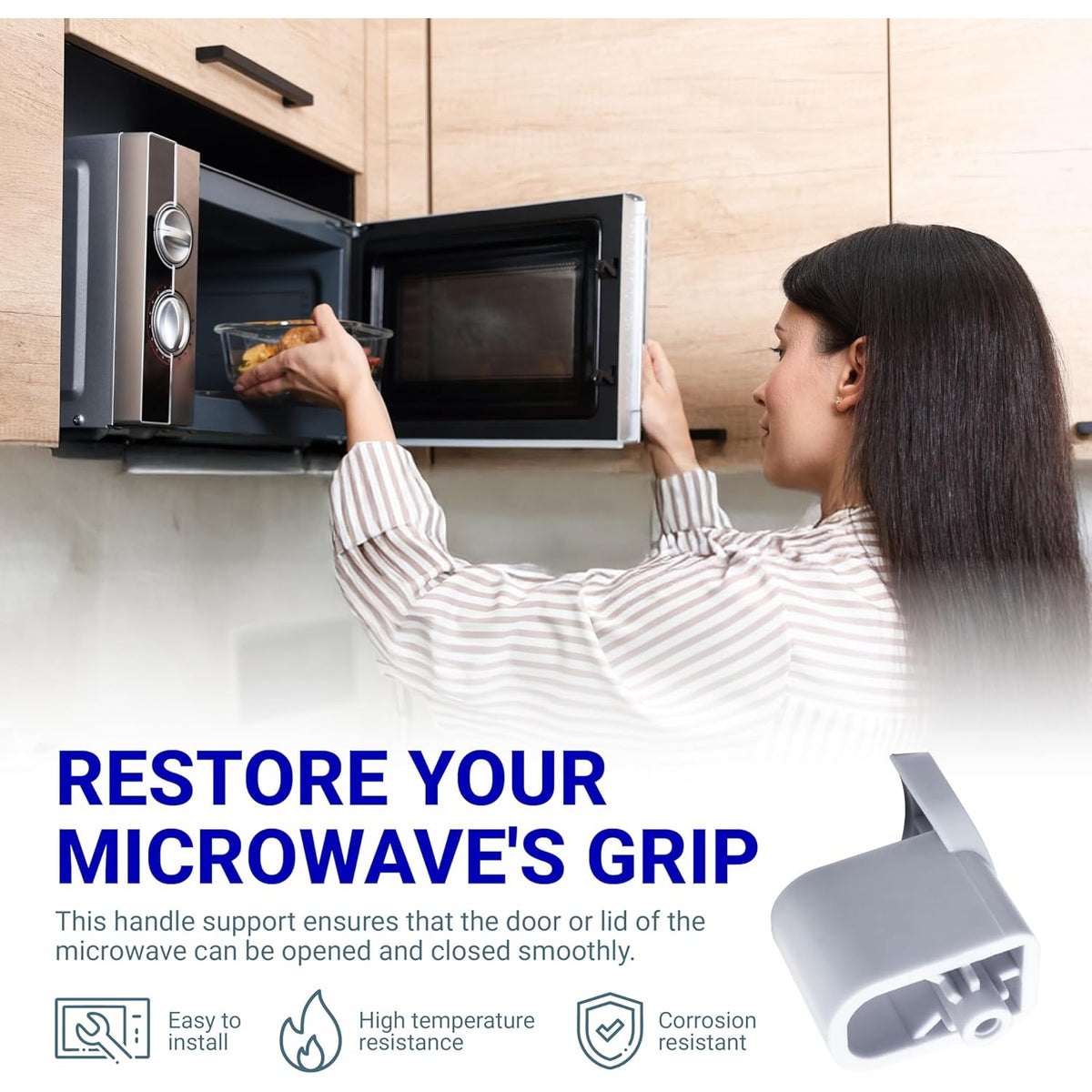
WB06X10943 Microwave Handle Support
3. When Should You Replace a Microwave Instead of Repairing It?
Separate the immediate safety decision from the financial decision. A fault may require you to stop using the appliance before anyone can determine whether repair or replacement is appropriate.
Stop Using a Microwave With Door Safety Problems
A damaged door, an insecure closure, or operation with the door open requires attention before further use. Contact the manufacturer or a qualified service professional, following FDA guidance.
Consider Replacement After the Assessment
- The technician cannot restore safe operation.
- The required compatible part is unavailable.
- The complete repair quote offers little saving over an equivalent installed replacement.
- Repeated failures make another repair unattractive for your budget.
Ask what the repair will resolve and what warranty applies. Use that information alongside the replacement quote before authorizing the work.
4. Microwave Repair vs. Replacement: A Cost Example
Use actual local quotes for your appliance. The figures below are illustrative USD amounts, not market averages or a BlueStars service quote.
| Cost item | Repair | Replacement |
|---|---|---|
| Complete repair quote | $180 | Not applicable |
| Equivalent new microwave | Not applicable | $450 |
| Removal and installation | Included in repair quote if required | $100 |
| Total | $180 | $550 |
In this example, repair costs approximately 33% of replacement: $180 ÷ $550 × 100. That saving is one factor in the decision; it does not predict the appliance's remaining lifespan.
Before comparing your quotes, confirm whether delivery, diagnostic fees, taxes, and any required installation work are included. Avoid counting a diagnostic fee twice if it is credited toward the repair.
5. FAQ
5.1 Is it cheaper to repair or replace a microwave?
It depends on the issue and the age of the appliance. Minor repairs like door or tray issues are usually cheap and worth fixing. However, major electrical repairs can cost close to a new microwave, making replacement more practical. Always compare repair cost with replacement price before deciding.
5.2 How many years should a microwave last?
Most microwaves last between 7 and 10 years with normal use. Higher-end models may last longer with proper maintenance. Over time, internal components naturally wear down, leading to reduced performance and more frequent issues.
5.3 Can I Replace Microwave Parts Myself?
Check the owner's manual for accessories the manufacturer permits users to replace. Do not treat internal components or door safety mechanisms as routine DIY repairs.
5.4 When Is Microwave Replacement the Better Option?
Consider replacement when a professional assessment finds that safe repair is not feasible, the required part is unavailable, or the complete repair quote offers little saving over replacement. Compare equivalent appliances and include installation costs.
5.5 Should I Repair a Microwave That Runs but Does Not Heat?
Do not order a heating component based on this symptom alone. GE recommends checking that the timer was not selected and that the door is properly closed. If those checks do not resolve the issue, arrange service.
Before choosing microwave repair or replacement, confirm the fault, check warranty coverage, and compare complete quotes. Keep the safety assessment separate from the price comparison.
Need a replacement component? Browse microwave replacement parts from BlueStars Parts and verify your full model number against the product's compatibility details before ordering. Consult a qualified service professional for door safety mechanisms and internal repairs.
Contact information:
8 The Green, Ste A, Dover, Delaware 19901-3618, United States
Website: https://bluestarsparts.com/
Reference:
HomeAdvisor. (2026, January 7). How much do microwave repairs cost?
U.S. Food and Drug Administration (FDA). Microwave Ovens.
GE Appliances. Microwave - Runs But Does Not Heat.Explore Related Articles


